A quiet note for SPX and 0DTE options traders
You called the direction. The day went your way. You still closed red.
Stopped on the shakeout. Back in late. Then three hours watching the premium drain out of a contract that should have worked.
That is not bad luck, and it is not your read. It is arithmetic, and it is decided before you click buy.
See why being right still loses ↓01 / The loop
9:31 AM. The first candle rips higher. You chase it. By 9:38, price has round-tripped through your entry.
11:30 AM. Volume dries up. The call sits there losing value while the chart stops moving in either direction. You were right about direction and it did not matter.
1:00 PM. You want it back. Bigger size. Worse strike. No invalidation written down. Tomorrow, the same scenario.
I ran this loop for years.
02 / The bill
Being right is not the same as being paid.
A 0DTE contract has to be worth what you paid for it by the time you sell. That takes points, and you can work out how many before you buy.
Take an at-the-money call bought at 9:31 on a day the market has priced to move 74.5 points. It needs about 7.7 points by 11:30 just to come back to what it cost. A strike twenty points further out needs about 10.
Now the part almost nobody checks. The 74.5 belongs to the whole session. Your trade has to be flat by 11:30. Only two of the six and a half hours are yours:
74.5 × √(2 ÷ 6.5) = 41 points.
Forty-one is the entire morning budget. Every strike you consider either fits inside it or it does not. Most of the strikes people buy on a phone at 9:31 need more than the day is willing to give.
That comparison takes ninety seconds, and it is the difference between a correct read that pays and a correct read that does not.
03 / The model
The budget, before the bell.
Yesterday's close and this morning's VIX give you the range the options market has already priced. One division:
close × VIX ÷ 15.87 = the day's expected move, in points.
On 16 October, SPX at 7,659.44 and VIX at 19.99 gave:
7,659.44 × 19.99% ÷ 15.87 = ±96.5 points.
The walls sit at the edges. The shelves sit halfway. Five lines, no software.
| Upper wall | 7,755.9 |
|---|---|
| Upper shelf | 7,707.7 |
| Close | 7,659.4 |
| Lower shelf | 7,611.2 |
| Lower wall | 7,563.0 |
Two things come out of that table.
The walls are where the hedging sits. As price moves, market makers buy or sell the underlying to stay flat, and that adjustment changes fastest at the strikes holding the most inventory. A move into a wall tends to slow. A move through one can accelerate. That is why a level you have never drawn stops your trade.
And if your strike needs more points than the day has, no read saves it. That is the whole reason the desk checks the budget before it checks the chart.
04 / Why The Vault exists
The levels took five minutes. Holding the rule when the tape argued at 10:15 was the hard part.
Alone, that discipline slips. Not all at once. One quiet morning at a time.
So I built the routine into a room. The plan is written before the trade. The review includes the losses.
05 / What changes when you take a seat
You stop trading yesterday's map.
8:30 AM: SPX, SPY and /ES levels from real dealer gamma. If the gap is big enough at 9:31, every line is redrawn around the real open.
You know what to do before price gets there.
8:35 AM: an If/Then ladder beside every level, and the four setups switched on or off for the day, each with its entry rule and its exact invalidation.
Your credit strikes stop being a guess.
9:50 AM: the exact 10-wide Bear Call and Bull Put strikes, with the defense line and the management rules written before you are tested.
One idea, and the contract is named.
Between 9:51 and 11:05, at most one setup scoring 7.5 or more, with the SPX level that proves it wrong and the 0.55 to 0.65 delta strike. Most mornings there is no idea at all, and that is the rule working.
Your morning has an end.
The idea is closed by 11:30 and the result is posted at 11:31, losses included. No afternoon left to give it back.
You find out whether the map held.
4:15 PM: the close checked against the morning map, the day's gamma shifts, and the three biggest institutional prints. One paragraph, not a report.
You start the week with a range.
Sunday 2:30 PM ET: next week's range, the strikes holding the most gamma across the week's expirations, and the Treasury yields.
Your size is a number, and the rules are on paper.
The Excel workstation turns your account size and your stop into a contract count. Under 25,000 dollars, the Micro-Account protocol runs the same plan on XSP or SPY. The 29-page manual and the case studies put every rule against real candles.
You are not deciding alone at 9:31.
60+ members post pre-bell plans, talk through the session, and review charts.
06 / Who this is not for
Skip the seat if you want a trade to copy every morning, guaranteed returns, or a room that does not mention the red days.
You need to accept that a stop is a stop, that most mornings have no trade, and that the 11:30 exit applies to you too.
If that sounds like a restriction rather than a relief, this is the wrong desk.
Do the math before you choose
One desk. Two ways to make it yours.
Try a month, or pay once for lifetime access. Both include everything listed above.
Second Cohort Price
Lifetime seat
$397 once
Saves $767 vs. one year of monthly.
One payment for lifetime desk access. No monthly membership fee.
Monthly membership
Start with a month
$97 / month
Full desk access, billed monthly.
Cancel any time. Your monthly price stays locked while your membership is active.
Twelve monthly payments total $1,164. Lifetime costs less from the fifth payment. Secure checkout by Stripe; your Discord invite appears after payment and arrives by email.
$27one-time
- Delivery
- Instant digital download
- License
- Yours forever
- Upgrade credit
- Full $27
Standalone workstation // $27
Prefer to run the numbers yourself?
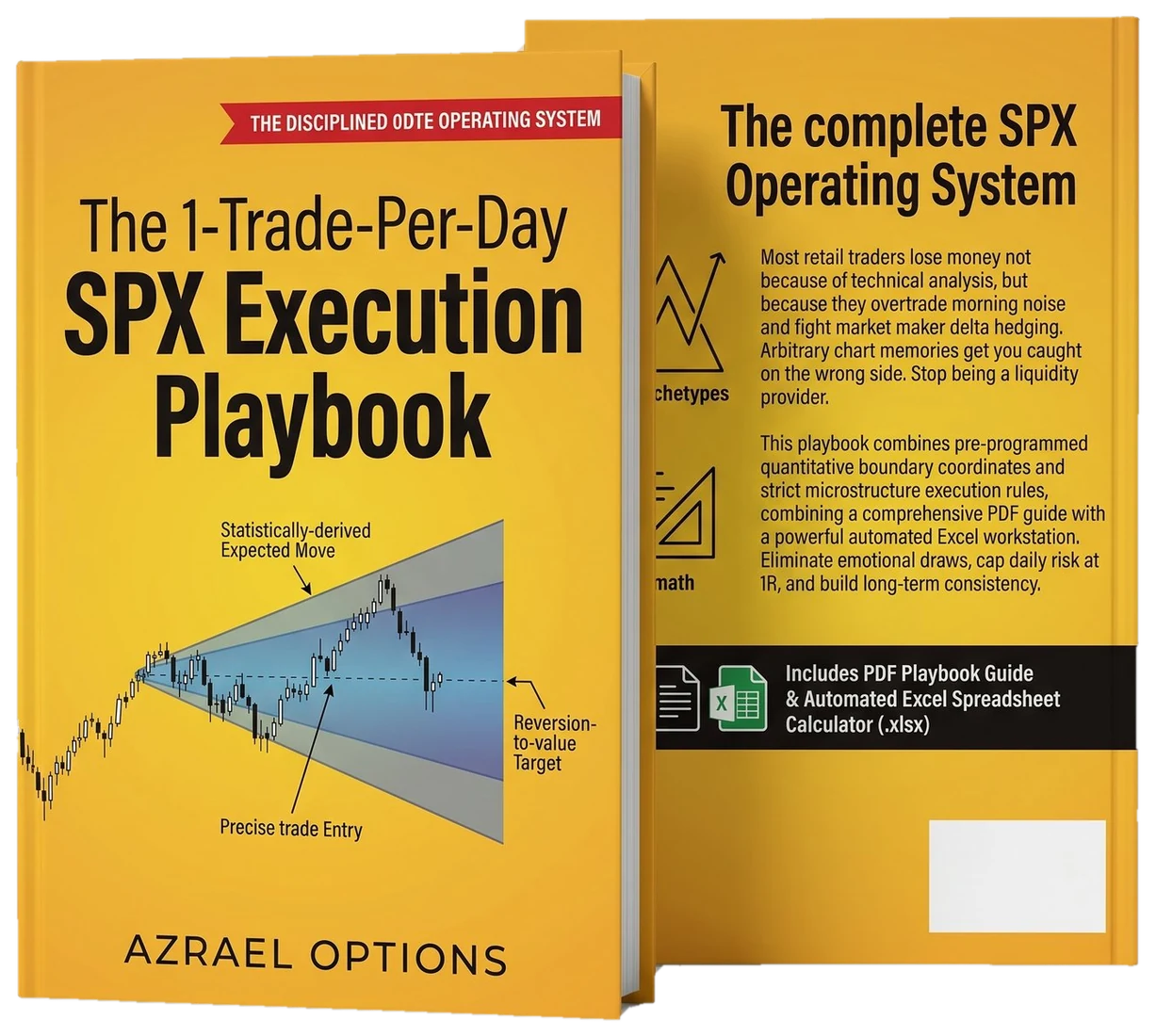
Get the Excel Workstation and 31-page standalone playbook. Calculate levels, re-anchor gap days, and size positions from your planned risk.
No Discord membership required. Actual losses can exceed planned risk.
Full $27 credit
Join later and credit $27 toward lifetime access or your first month. Use your email's code under either seat button. Later monthly payments stay $97.
P.S.
If you start with the workstation, test the levels for two weeks without placing a trade. See where they hold and where they fail.
Join the desk if you want the daily plan and the room behind it. The $27 comes off your seat.
Azraël
Straight answers
Questions I get asked most
Do I need the Discord seat to use the $27 workstation?
No. The Excel workstation and 31-page standalone playbook work on their own. The seat adds daily maps, desk updates, and the community.
I have a job. Do I have time for this?
You can study the maps and reviews around work. Taking a morning idea requires availability from 9:50 to 11:30 AM ET. Credit spreads have separate management rules.
Is this signals or trade alerts?
The desk posts spread strikes and at most one qualifying morning idea. Each idea includes invalidation and an exit deadline. Scores measure rule checks, not win probability. You decide whether to trade.
Can I cancel the monthly membership?
Yes, through the receipt Stripe emails you. Access continues until your paid period ends. If you return later, the price then applies.